
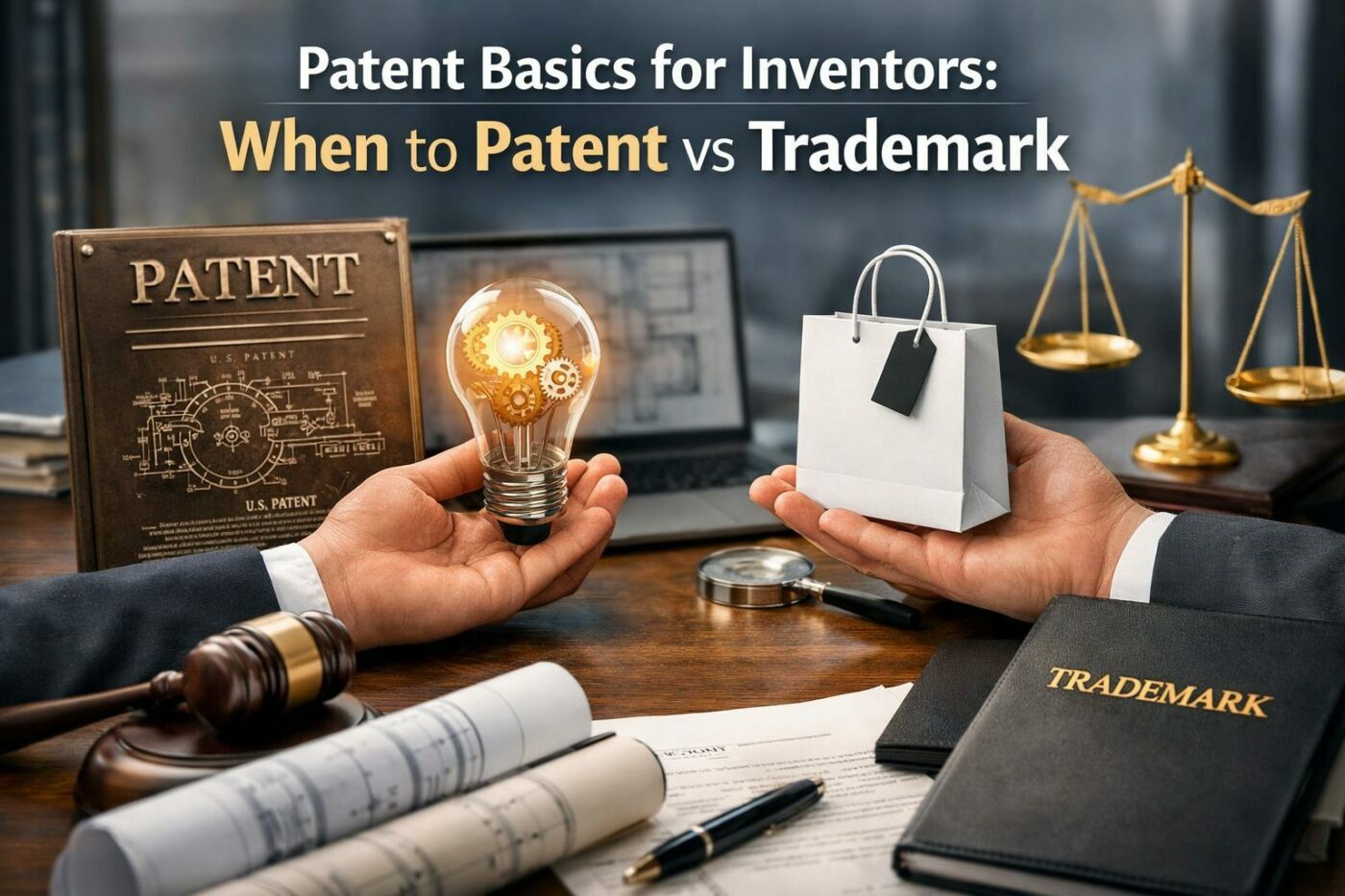
Direct answer: Deciding when to patent vs trademark depends on what you need to protect: patent protection covers a novel functional invention or technical solution, while a trademark protects the name, logo or slogan that identifies your product or business. For most inventors the right approach is a combined strategy—seek patent protection for the invention and register trademarks to secure the brand identity.
Many inventors worry about costs, timing and whether a single filing will protect both their product and its name. This article explains the differences between patents and trademarks, practical steps to protect both, and how to prioritise filings to reduce commercial risk while preserving future options.
How should an inventor decide when to patent vs trademark?
Start by separating the technical features from the brand elements. Ask two simple questions: does the asset solve a technical problem, and is it new and non-obvious? If yes, a patent search and possible patent application are appropriate. If the asset is a name, logo or distinctive packaging that distinguishes your goods or services, pursue trademark protection and a trademark availability search.
Practical priorities often are:
- File a patent application (or claim priority) before public disclosure if you rely on novelty.
- Start a trademark availability search early and consider filing a trademark application before heavy marketing.
What does a patent protect and when is it the right choice?
Patents protect technical inventions: products, devices, methods or improvements that meet criteria of novelty, inventive step and industrial applicability. A patent gives the owner exclusive rights to prevent others from making, using or selling the claimed invention in the jurisdiction(s) where it is granted. Use patents when the commercial value depends on the technical solution rather than just the brand.
Note that patent rights are territorial and time-limited, and obtaining a granted patent can take several years. Consider costs, potential market size in target jurisdictions and whether secrecy or trade secrets could be an alternative.
What does a trademark protect and when should you register one?
Trademarks protect signs that identify the commercial origin of goods or services: names, logos, taglines, colours or shapes used as identifiers. Registration is not mandatory in many places, but a registered trademark provides stronger, enforceable rights and clearer remedies against infringement.
Register a trademark when you plan to invest in marketing, expand into new territories, or license/franchise the business. A trademark registration also helps prevent competitors from using confusingly similar marks in your fields of trade. Remember to select classes carefully under the Nice Classification and run a trademark availability search to reduce opposition risk.
Can the same product be both patented and trademarked?
Yes. Many products benefit from both forms of protection: a patent for the technical features and one or more trademarks for the product name, logo or distinctive packaging. For example, a novel coffee machine might be protected by a patent on its brewing mechanism and by a trademark for the brand name and logo.
Coordinating the two protects market position from technical copying and brand confusion. Use patents to secure exclusive manufacturing rights and trademarks to control branding, sales channels and reputation.
Practical example: a hardware invention and its brand
An inventor creates a compact, energy-efficient water pump for small boats. The pump’s novel impeller and sealing method could justify a patent application after a prior-art search. The pump’s distinctive name and logo should be checked in a trademark availability search and registered in the countries where the inventor plans to sell. Filing strategy: preserve patent novelty by avoiding public disclosure before filing, and file a trademark application early enough to deter similar brand names.
What practical steps should an inventor take first?
Follow a clear checklist to balance cost and risk:
- Run or commission a patentability search and a trademark availability search.
- Decide primary commercial territories and prioritise filings there (national, EUIPO, UKIPO or international via WIPO/Madrid).
- Avoid public disclosure of patentable details before filing; marketing names can be tested once a trademark search is complete.
- Consider provisional or priority patent filings to buy time while assessing markets and costs.
For official procedural details, consult trusted sources such as the WIPO, EUIPO and your national office (for the UK, the UKIPO).
What common mistakes put IP protection at risk?
Inventors often make these avoidable errors:
- Public disclosure before filing that destroys novelty for patents.
- Choosing a weak or descriptive trademark that cannot be registered or enforced.
- Failing to conduct adequate availability searches, leading to oppositions or infringement claims.
- Assuming a company name or domain equals trademark protection—they are distinct rights.
- Neglecting territorial strategy and over- or under-committing to jurisdictions.
Avoiding these mistakes preserves options and reduces downstream costs and disputes.
When should an inventor seek professional IP assistance?
Seek professional advice when:
- You are unsure whether the innovation meets patent criteria.
- You plan cross-border sales or investment and need coordinated national, EU or Madrid System filings.
- There is a risk of conflict with existing patents or trademarks.
- You need an IP strategy that aligns with commercial plans, licensing or fundraising.
A professional assessment can combine a patentability opinion with a trademark availability search to recommend a cost-effective filing strategy. For tailored support, consider a combined approach such as the combined trademark and patent services offered by MARKANDUS.
How can MARKANDUS help with patents and trademarks?
MARKANDUS can help by organising coordinated searches, advising on filing sequence and jurisdictions, preparing patent drafts with input from technical experts, and filing trademark applications with the appropriate classes. This joined-up service supports commercial goals—protecting the invention while securing the brand identity where it matters most.
To discuss an initial IP strategy review and availability searches, request a personalised consultation via MARKANDUS’s contact page: Contact MARKANDUS for combined trademark and patent services.
Este apartado refuerza la idea principal de when to patent vs trademark de forma natural para que el contenido sea más claro y útil.
You may also be interested in
- Why Trademark Registration Is Essential for Growing Businesses. Contact MARKANDUS to learn how trademark registration protects your brand and business value—get started.
- Protecting Trademarks Online: Domain, Social & Marketplace Tips. Secure digital brand assets and prevent cybersquatting.
- Step-by-Step Guide to Registering Your Trademark in 2026. Contact MARKANDUS to simplify trademark registration with expert guidance and fast filing—start here.
- Responding to Trademark Office Actions: A Practical Checklist. Navigate office objections and refusals with expert help.
- Top 7 Trademark Mistakes Businesses Make (And How to Avoid Them). Avoid costly trademark errors.
- How to License Your Trademark and Create New Revenue Streams. Monetize your brand with smart licensing agreements.
Frequently asked questions
Do I need a patent before I market my invention?
Not always, but if novelty is essential you should file a patent application or a provisional/priority filing before public disclosure. Otherwise you risk losing patent rights in many jurisdictions.
Can I register a trademark internationally in one application?
Yes—international trademark protection can be pursued through the Madrid System administered by WIPO, but you must designate the countries where protection is needed and check local requirements.
Will a registered trademark stop technical copying of my product?
No. A trademark protects brand identity, not functional features. To prevent technical copying you need appropriate patent protection or other remedies such as design rights or trade secrets where applicable.
How do I know whether to keep details secret or to patent them?
If the invention can be kept as a trade secret without losing commercial value and is hard to reverse-engineer, secrecy may work. If competitors could independently invent or reverse-engineer your solution, a patent is usually preferable.
What is involved in a trademark availability search?
A trademark availability search checks registered and pending marks and common-law use that might conflict with your proposed mark. It reduces the risk of refusals, oppositions or infringement claims and informs class selection.